TMJ/TMD Treatments
TMJ / TMD is available at these locations:
A temporomandibular joint disorder (TMD) can show up in more ways than one: jaw pain, clicking, headaches, and trouble chewing all point to it. At Aesthetic Dentistry, our doctors treat it conservatively and without surgery, drawing on custom night guards, splint therapy, and therapeutic injections to ease your pain and bring jaw function back to normal.
What it is
TMD is a disorder of the temporomandibular joint (TMJ), the hinge that connects your jaw to your skull. It can bring on pain, clicking, locking, or limited jaw movement.
Who it's for
Anyone with jaw pain or clicking, chronic headaches or migraines, teeth grinding (bruxism), facial tension, or trouble opening the mouth all the way.
How we help
A thorough clinical evaluation and digital imaging, followed by conservative, non-surgical care: custom oral appliances, therapeutic Botox injections, and bite adjustment.
Letting jaw pain or clicking shape your day? Lasting relief starts with a proper diagnosis.
Signs You May Have TMD
Common Symptoms
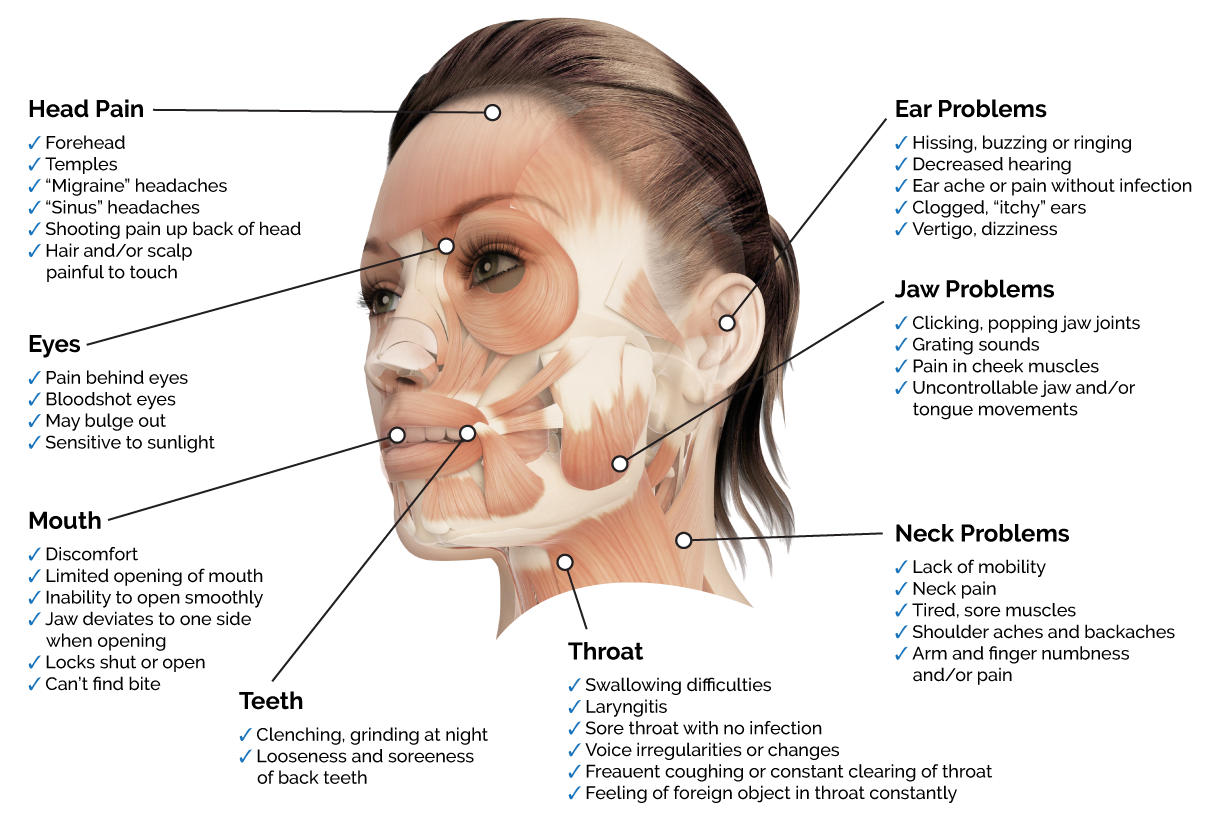
- Tenderness or pain in the jaw, the face, or around the ear
- Clicking, popping, or grinding as you open or close your mouth
- A jaw that locks open or locks shut
- Chewing that feels uncomfortable or difficult
- Chronic headaches or migraines, often worst in the morning
- Earaches, or ringing in the ears (tinnitus)
- Stiffness or pain through the neck and shoulders
Common Causes
- Bruxism: Ongoing clenching or grinding of the teeth, frequently during sleep
- Jaw injury: Trauma from an accident, a sports hit, or a dental procedure
- Arthritis: Degenerative changes within the TMJ joint
- Bite misalignment: An uneven bite loads the joint unequally
- Stress: Built-up tension drives jaw clenching and tires the muscles
- Disc displacement: The soft disc inside the joint slips out of position
Treatment Options
Night Guards & Splint Therapy
- Occlusal (night) guard: A custom plastic appliance worn as you sleep, cushioning the teeth against grinding and clenching
- TMJ splint: Shifts the lower jaw to take stress off the joint and let overworked muscles relax
- NTI guard: A compact appliance over the front teeth only; it is less bulky, sets off no gag reflex, and is proven to cut clenching intensity
- Every appliance is custom-made by our doctors for a precise, comfortable fit
- Conservative and reversible, this is often the first-line treatment for TMD
Therapeutic Injections
- Botulinum toxin (Botox): Eases overactive jaw muscles, lowering clenching force and relieving pain
- FDA-approved since 2011 for treating chronic migraine and facial pain
- Research puts roughly 85% of TMJ pain disorders down to muscle issues, which is why Botox works so well
- The muscles keep functioning normally, just relaxed enough to head off painful contractions
- It is a quick in-office procedure, and the results last 3–4 months
Additional Therapies
- Bite adjustment: Carefully reshaping tooth surfaces to even out the bite
- Physical therapy exercises: Gentle stretches and strengthening moves for the jaw muscles
- Stress management: Relaxation techniques that cut down on tension-driven clenching
- Medication: Anti-inflammatory drugs or muscle relaxants to calm acute flare-ups
Tips for TMD Relief at Home
- Sleep on your back so you are not pressing on the jaw
- Lean on soft foods that spare you heavy chewing, like yogurt, soup, scrambled eggs, and fish
- Pass on chewing gum, ice, and anything hard or sticky
- Keep jaw movements moderate, and cradle your chin when you yawn
- Hold moist heat or an ice pack to the jaw for 10–15 minutes
- Lean on stress-reduction techniques to curb unconscious clenching
Night guards, Botox therapy, and more: we draw on several approaches to find what works best for your TMD.
What to Expect at Your Visit
Visit Steps
- Comprehensive evaluation: our doctors check your jaw, bite, and muscle function and go over your symptoms in detail
- Imaging: Digital X-rays or other imaging may be brought in to evaluate the joint and rule out other conditions
- Diagnosis: Drawing on your exam and imaging, our doctors explain your particular TMD type and what is contributing to it
- Treatment plan: We walk through every option, from appliances to injections to exercises or a mix, and recommend a personalized approach
- Follow-up: Regular check-ins track your progress and fine-tune treatment as needed
Helpful Tips
- For the week before your visit, jot down your symptoms, noting when the pain is worst and what sets it off
- Bring along a list of the medications or supplements you take
- Conservative treatment tends to improve TMD a great deal, and surgery is rarely needed
- A night guard can take a few nights to get used to, though most patients adjust quickly
- If chronic migraines are part of the picture, say so; one treatment may address both at once
Frequently Asked Questions
The two terms get used interchangeably, but they point to different things. TMJ stands for the temporomandibular joint itself, the hinge that connects your lower jaw to your skull. Everyone has one on each side, and they are what let you open, close, and slide your jaw to chew and speak.
TMD, short for temporomandibular disorder, is the actual condition that develops when that joint, the muscles around it, or the supporting structures stop working properly. So when people say they have 'TMJ pain,' what they usually mean is TMD, a disorder of the TMJ. The distinction matters less than the takeaway: if your jaw joint is causing pain, clicking, or limited movement, that is TMD, and it is treatable.
Sometimes, yes. Mild TMD that flares up after a stressful stretch or a few nights of clenching often settles down on its own with some simple self-care: resting the jaw, sticking to softer foods for a while, easing stress, and avoiding gum and other hard, chewy foods. For many people, a short-lived bout of jaw soreness resolves without any formal treatment.
What should not be ignored is TMD that is chronic, recurring, or getting worse. Persistent clicking, locking, or pain that lingers usually signals that the joint or muscles need real treatment to keep the condition from advancing. Because early TMD generally responds better and faster than a long-standing case, stepping in sooner rather than later tends to lead to better outcomes.
If you clench or grind your teeth, a condition called bruxism, a custom night guard is one of the most effective and affordable treatments available for TMD. Worn while you sleep, it cushions your teeth and takes pressure off the overworked joint and muscles. A good night guard typically:
- Shields the teeth from the wear and chips that grinding causes.
- Eases strain on the TMJ so the joint can rest and recover.
- Relieves the morning headaches, jaw soreness, and facial tension that often come with clenching.
Not everyone with TMD needs a night guard, so the right call depends on what is driving your symptoms. At your evaluation, our doctors check your bite and muscle function and let you know whether a custom night guard is the right fit for you.
Yes, for the right patient. Botulinum toxin, better known as Botox, has carried FDA approval for chronic migraines since 2011, and it is widely used to relieve the muscle-related pain that drives much of TMD. It works by relaxing the overactive jaw muscles that clench and grind, which lowers the force on the joint and eases pain at its source.
Importantly, the muscles keep functioning normally; they are simply relaxed enough to stop the painful, involuntary contractions. The treatment is a quick in-office procedure, and the results usually last 3 to 4 months before a touch-up is needed. Many patients with muscle-driven TMD improve significantly, and when chronic migraines are part of the picture, a single course of treatment can sometimes help with both.
Almost never, and that is genuinely reassuring news. The vast majority of TMD cases respond well to conservative, non-surgical care. That includes custom night guards and splints, Botox for muscle-driven pain, gentle jaw exercises, bite adjustment, and simple lifestyle changes. For most patients, this kind of treatment is enough to bring real, lasting relief.
Surgery only enters the conversation in the small number of cases where conservative approaches have genuinely been exhausted and there is significant structural damage within the joint. Even then, it is treated as a last resort rather than a starting point. Our whole approach to TMD is built around the least invasive option that works, so you can expect us to explore conservative care fully before anything more involved is ever considered.
It varies with the cause and severity, but many patients notice a meaningful difference within a few weeks of starting treatment. TMD care is less a one-time fix than an ongoing plan tailored to what is driving your symptoms, so the timeline looks a little different for each approach.
A night guard, for instance, is worn each night on a continuing basis to manage grinding, while Botox results tend to appear within 1 to 2 weeks and last 3 to 4 months before a repeat treatment. Throughout, our doctors track your progress at follow-up visits and adjust the plan as you improve, so the treatment keeps pace with how your TMD is actually responding.
Stress is one of the most common contributors to TMD, even though it is easy to overlook. When you are tense, you tend to clench your jaw and tighten the surrounding muscles, often without realizing it and frequently during sleep. Over time, that repeated, low-grade strain wears on the TMJ and the muscles that move it, which is how everyday stress turns into very real jaw pain.
Because stress works through clenching and muscle tension, managing it can ease TMD symptoms considerably. Relaxation techniques, regular exercise, and enough sleep all help reduce the unconscious clenching that aggravates the joint. For many patients, pairing those habits with a night guard addresses both sides of the problem at once: the guard protects the joint while the stress management reduces what is straining it in the first place.
It varies quite a bit from plan to plan. Dental insurance often helps cover night guards and occlusal appliances, since those are dental devices, while Botox for TMD may fall under medical insurance when it is documented as a medical necessity rather than a cosmetic treatment. TMD care can therefore draw on both kinds of coverage, depending on which treatments you need.
Sorting that out is something we handle for you. At our Orland Park, Frankfort, and Oak Lawn offices, we verify your benefits and explain in plain terms what is likely to be covered before treatment starts, so there are no surprises. For any out-of-pocket portion, we can also walk you through financing options to keep your TMD treatment affordable.
You do not have to live with jaw pain. Book a TMJ evaluation and find out which treatment is right for you.