Implant Bridge
Missing Multiple Teeth (Implant Bridge) is available at these locations:
A traditional bridge borrows support from the teeth on either side of a gap. An implant-supported bridge does not; it anchors directly to your jawbone instead, which is why it is the most effective way to rebuild your smile, your bite, and your confidence when several neighboring teeth are gone. That direct anchoring preserves bone, protects the surrounding teeth, and gives a permanent, natural-looking result. At Aesthetic Dentistry, our doctors will build a custom treatment plan to replace your missing teeth and bring back full function.
What it is
Two or more dental implants, rather than your natural teeth, hold a fixed bridge in place, restoring three or more missing teeth in a row with a permanent restoration you never take out.
Who it's for
Anyone missing several teeth in a row who wants a stable, permanent fix that protects the bone and leaves the healthy neighboring teeth alone.
How we help
Digital imaging that guides each implant to the ideal spot, a bridge custom-designed to match your natural teeth, and a plan shaped to your particular situation.
There is no reason to let missing teeth hold you back. An implant bridge brings your smile back permanently.
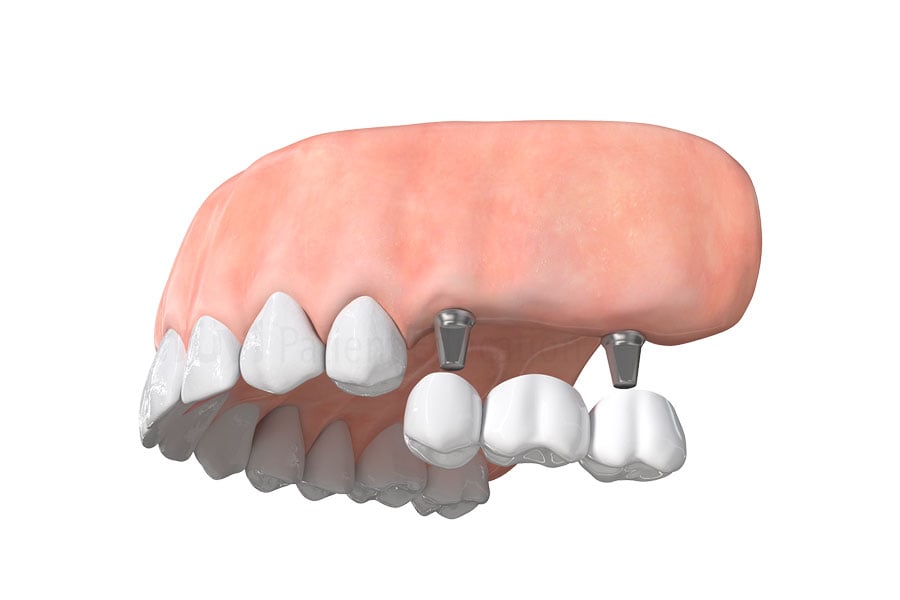
How an Implant Bridge Works
- To serve as anchors, two or more titanium implants are placed into the jawbone
- Onto those implants attaches a custom bridge of connected porcelain crowns
- In one fixed restoration, the bridge replaces three or more missing teeth
- There is no filing down or crowning of healthy teeth, unlike a traditional bridge
- By stimulating the jawbone, the implants prevent the bone loss that follows missing teeth
- The finished result looks, feels, and functions like your natural teeth

Why Replace Missing Teeth Now?
- Bone loss accelerates: With no tooth roots left, the jawbone resorbs and shrinks quickly
- Teeth shift: Neighboring teeth slide into the empty spaces, throwing off your alignment and bite
- Remaining teeth are at risk: Those picking up the slack take on extra stress and can be lost as well
- Chewing becomes difficult: With teeth missing, a full range of foods becomes harder to manage
- Facial changes: As bone disappears, the jaw can take on a sunken, aged look
- Act sooner and the treatment stays simpler and more affordable
Advantages of an Implant Bridge
- Beautiful, natural appearance: Porcelain crowns crafted to match your existing teeth down to the detail
- Eat any food: Fixed permanently in place, an implant bridge lets you bite and chew with full confidence
- No shifting or moving: Anchored straight to the jawbone, it stays rock-solid
- Preserves bone: The implants stimulate the jawbone and head off the deterioration tooth loss brings
- Protects adjacent teeth: No grinding down of healthy neighbors, the way a traditional bridge requires
- Long-lasting: Maintained properly, an implant bridge can last decades
The Treatment Process
- Consultation: With digital X-rays and CT scans, our doctors evaluate your teeth and jawbone
- Treatment plan: Your plan is built around how many teeth are missing and how much bone is available
- Implant placement: Under local anesthesia, titanium posts are surgically set into the jawbone
- Healing period: Over 3–6 months the implants fuse with the bone, a process called osseointegration
- Bridge fabrication: Custom porcelain crowns are designed and joined together to form your bridge
- Final placement: Permanently fixed to the implants, the bridge completes your new set of teeth
An implant bridge fills the gaps without putting your healthy teeth at risk. Book a consultation today.
What to Expect at Your Visit
Visit Steps
- Evaluation: our doctors examine your mouth, look over your imaging, and talk through your goals and options
- Custom plan: You get a detailed plan spelling out timeline, cost, and what each stage holds
- Surgery: Implants go in within a comfortable office setting, with sedation available
- Progress checks: Follow-up visits keep an eye on healing and make sure things stay on track
- Final restoration: After healing, your custom bridge is permanently attached
Helpful Tips
- Where bone loss has been significant, bone grafting may come before implant placement
- Support healing by following every post-surgical instruction closely
- For the first few days after implant surgery, keep to soft foods
- Brush and floss around the implant bridge daily to keep your hygiene excellent
- Show up for each of your scheduled follow-up appointments
- Cared for properly, your implant bridge will serve you for many years
Frequently Asked Questions
An implant bridge is efficient by design: it does not need one implant for every missing tooth. Two implants will usually carry a bridge that replaces three to four teeth in a row, since the implants on each end support the replacement teeth that span between them.
Longer spans, or gaps where the bone varies in density, may call for more implants to share the load safely, and our doctors will settle on the right number based on your jawbone density, where the gaps fall, and how many teeth are being replaced, so your implant bridge has solid, evenly distributed support.
For most people who are candidates, yes. An implant bridge anchors directly to the jawbone, which means it spares your healthy neighboring teeth from being ground down to serve as supports, keeps the jawbone stimulated and preserved where the teeth are missing, and tends to last far longer.
A traditional bridge, by contrast, leans on the neighboring teeth for support, so those healthy teeth have to be filed down and can take on extra stress that weakens them over time, and it does nothing to stop the bone loss under the gap. There are still situations where a traditional bridge makes sense, and our doctors will give you a straight comparison for your case.
Counting from the first implant placement to the finished restoration, expect 4 to 8 months for an implant bridge, most of it healing time while the implants fuse with the jawbone in a process called osseointegration. The active appointments are relatively short; it is the biological healing in between that sets the pace.
Should bone grafting be needed first, add another 3–6 months for the graft to heal before the implants go in. It can feel like a long road, but each stage is building a permanent result, and our doctors lay out the exact timeline for your situation so you always know what comes next.
This is a common situation when teeth have been missing for a while, because the jawbone starts to shrink once the tooth roots are gone. At your consultation, our doctors will check your bone density with digital X-rays and CT imaging to see exactly how much bone is available where the implants need to go.
Where bone has been lost, bone grafting rebuilds the area into a solid foundation for implants, and it is a common, well-established procedure. Once the graft has integrated, your implant bridge can proceed on stable bone. Acting sooner rather than later often means less bone loss to rebuild, which keeps the overall treatment simpler.
An implant bridge is a custom restoration, so the price reflects what your specific case involves. The main factors are:
- The number of implants needed to support the bridge.
- Whether bone grafting is required to prepare the site first.
- How many teeth the bridge replaces and how complex it is.
- The materials used for the final porcelain bridge.
You will get a detailed estimate at your consultation, with no surprises later, and we offer flexible financing options to keep treatment affordable. Many patients find an implant bridge well worth it, since it can last for decades and protects the neighboring teeth and bone that a traditional bridge does not.
Caring for an implant bridge is much like caring for natural teeth, with one small addition. Brush twice a day and floss daily, and because a bridge connects several crowns together, clean underneath it as well using a floss threader, interdental brush, or water flosser to clear away anything that collects between the bridge and the gum.
The implants cannot decay, but the gum and bone that hold them still need healthy upkeep, so keep up with regular checkups and cleanings where the bridge and implants can be inspected. Maintained this way, implant bridges can last for decades, which is a big part of what makes them such a worthwhile long-term replacement for multiple missing teeth.
Win back your smile and your confidence. Book your implant bridge consultation today.